Sunday, February 23, 2020

The Arca-Swiss P0 ballhead

When I bought a smaller travel/hiking tripod, I wanted a smaller lighter ballhead that would match it well.  I love FLM ballheads and nearly bought the CB-32F or CB-38F, but a friend convinced me to give the Arca-Swiss P0 a try.


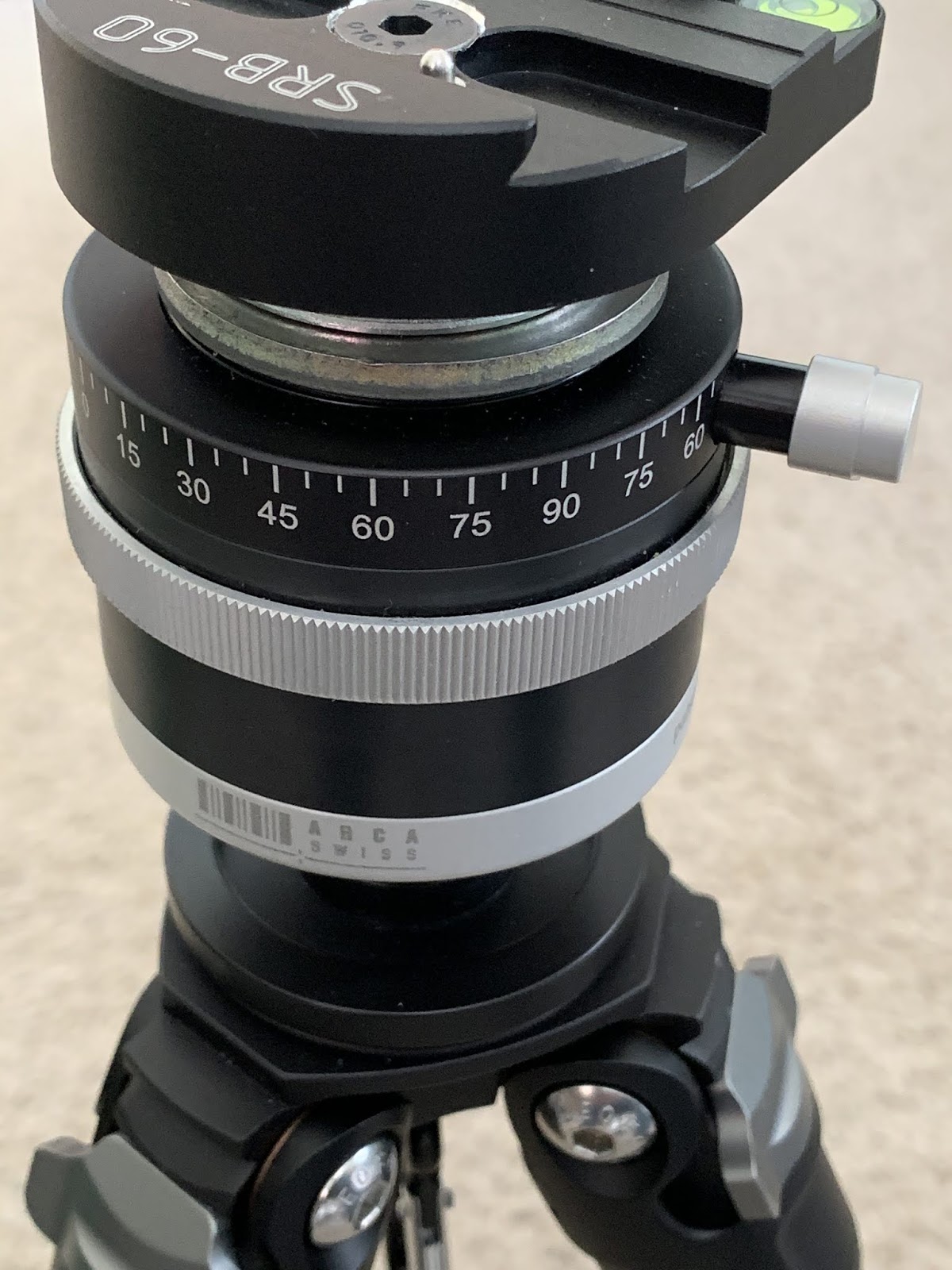
The head is different from the average ballhead because the mechanism is inverted.  The stem mounts on the tripod and the mechanism sits on top.   This upside-down design prevents water and snow from getting inside.

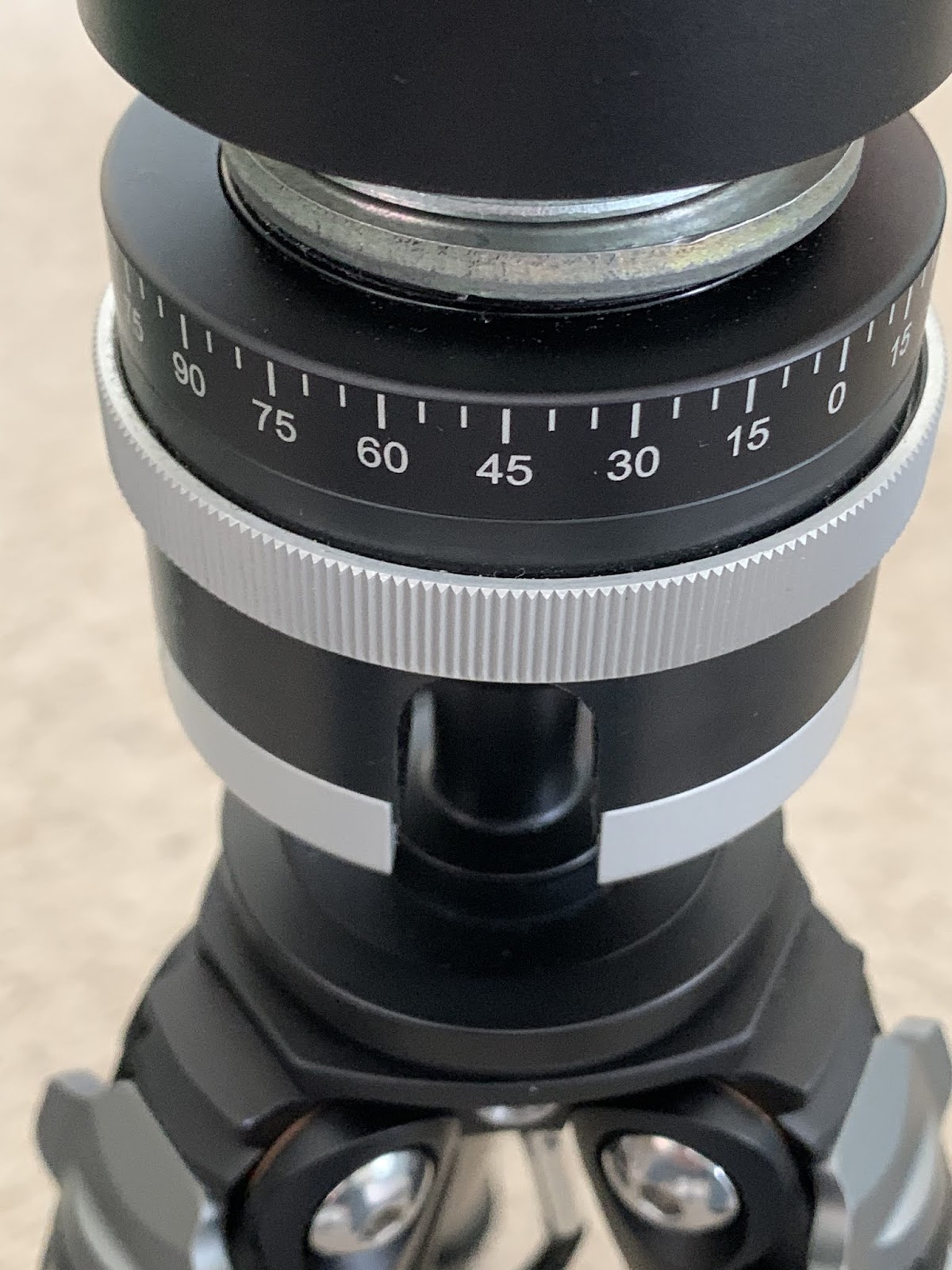
The main locking control is a bit unusual too... instead of a knob or lever like most heads, it has a ring that wraps around the entire head.  This means you don't need to worry about the orientation of the head.  A quick twist tightens or loosens the head.  It's the same from any angle.

Mine didn't come with a quick release and I ended up using an FLM SRB-60 clamp, which is round and matches the size of the P0 perfectly. The knob is short and doesn't poke out too far either, which was important to me in keeping the overall package as small as possible. I had to modify the clamp to use an M6 screw flush in the clamp, and raised the clamp a bit using fender washers to keep the P0's pano knob from hitting the clamp's knob.

Removing the included screw took just a little force from an 11mm socket.

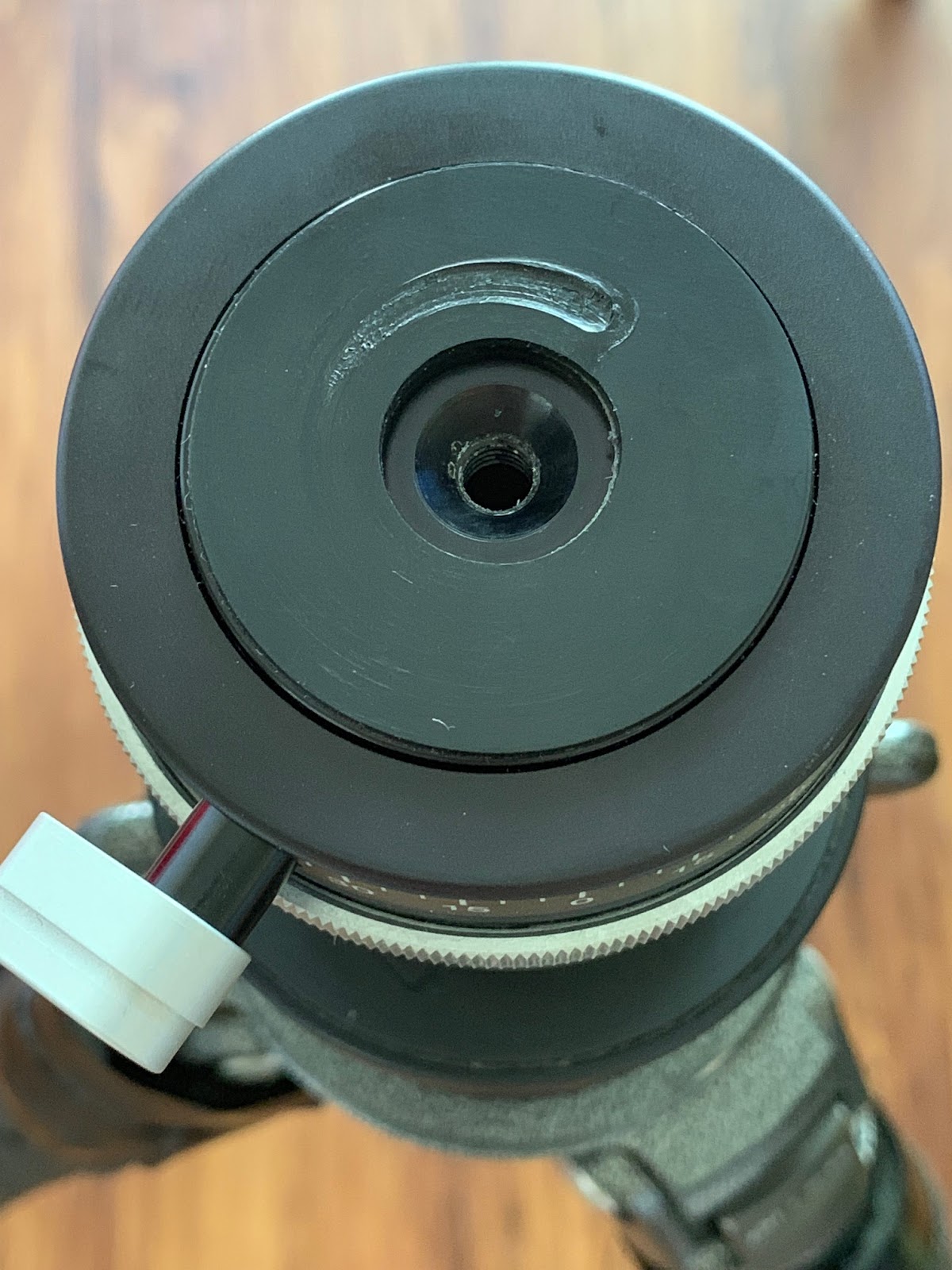
Be careful what you put on top. When I put a clamp directly on it, I hadn't realized the bottom of the clamp had a protrusion that would dig into the rotating platform.


A gripe I have about traditional ballhead controls is when I want to shoot the sky.  I need the drop notch to face me in that case.  Normally, I'd look down for macros, so I want the main knob to my left while the drop notch is opposite from me.  But when I want to aim up, a normal head has to be turned around, and suddenly using the knob is awkward.  The P0 solves this easily since the orientation doesn't matter.

Also, built in to the head is a rotating platform on top.  This makes panoramas easy... just level the head and rotate the top.  No need to spend more on a leveling base or a panning clamp.  The rotation is smooth and well-damped.

Opposite the pan lock lever is a drop notch that allows the head to be tilted up to 90 degrees if desired. Unlike the Arca-Swiss Z1 that I had for a few years, when I tilt the head into the drop-notch, I can feel the increased resistance from the aspherical ball as it tilts.  So the aspherical ball really seems to work.


I intended the P0 for smaller lenses and landscape use, but I found it plenty strong to hold a 100-400 mounted without slipping.

But here is the big surprise for me... the P0 doesn't shift as it is locked down, which is one of the big features I love about my FLM head.  It makes lining up shots very easy.  It makes precise compositions very easy, particularly for closeups where any shifting is very noticeable.  I haven't compared them directly but I think the P0 may be just as shift-free as my FLM CB-48F.

In a nutshell, I was surprised by how much I like the P0.


Saturday, February 22, 2020

Leofoto LS-284C travel tripod

Leofoto is a name that I've seen come up quite often in forums and reviews.  So when I decided to get a compact travel tripod for hiking, I researched the Leofoto LS-284C.  I compared it against several brands and in the end, decided it had the best bang for buck, being at most one-third the price of the equivalent Really Right Stuff but nearly as stiff according to the Center Column.  It's actually #2 in the travel tripod stiffness ranking, behind RRS and just above Gitzo.  Impressive!


It arrived in a nicely made, padded case.  The case has enough room for a head mounted as well as the tripod itself, which is a nice touch.  I wish the case had webbing to make it easier to attach to a backpack.


The tripod came with spikes for certain terrain, and they happen to fit many other tripods via standard 3/8" threads.  To use them, remove the rubber feet on each leg and screw in the spikes.  Try not to stab anyone.


It came with a carabiner to hang your bag for extra stability, which you have to screw in yourself.  I used a little loctite to hold it in place.


There was a nice multi-tool included as well, but the parts have a hard time reaching some of the tripod screws, so I assume it is a generic tool.  It's a cool idea but not actually useful as designed.  You'll need to keep your existing hex wrenches handy.


The build quality on the LS-284C appears to be as good as anything I've seen from any other maker, including my own Gitzo and a friend's RRS. I've read of quality control issues in a couple of Leofoto tripods but mine works beautifully.

The LS-284C has 4 leg sections.  The leg locks take an easy quarter turn or so to loosen and retighten.


Fully extended on a flat surface, the tripod is only about 4' tall.

The legs spread independently which is useful for uneven terrain. It can spread wide and go to nearly ground level.  The leg stops are spring loaded and easy to use.  Just pull them out and they lock open so you can widen the legs and get lower. When you move the leg out to the widest setting, they automatically snap back into position, and snap to the next stops as you close the leg back up.

As low as it can go

Stop pulled out, ready to adjust.


It did not come with a center column.  For my intended use of shooting landscapes while hiking, I didn't need one.

The apex is quite small at about 47mm in diameter.  My FLM CB-48F head is just a little too big for it.  It works fine, but I ended up with a smaller ballhead.  The apex is so small that with the hook hanging and the legs at the narrowest angle, my pack won't hang directly on the hook.

My only real gripe is something I read about from several other reviewers... the legs feel a bit narrow on the tallest setting.  So the first thing I did was take the legs off and void my warranty by filing the stops.  This widened the stance a bit, making it more stable, at the cost of a little less maximum height.

The tripod is very light, and compared to my bigger Gitzo, feels weightless.  Put a small, lightweight (but sturdy!) head on top and you have a winner for hikes.   Given how light it is, I pay close attention when it is windy.  I don't quite trust it in wind as much as my 3-series Gitzo (which was nearly blown over in a very strong wind just once - I caught it).  I will hang my backpack from the apex once I extend the hook.  And maybe I'll widen the stance just a little more.

It was a very good purchase.  If you need a solid travel tripod, take a look.

Monday, February 3, 2020

Camera backpack options

Since there is no such thing as "one size fits all" with backpacks, much less camera backpacks, I thought I'd list a bunch that I became aware of during my searches.  I'll list them alphabetically by brand, and mention features that I think may be relevant to some of you.

One thing I don't take very seriously is volume.  Some companies have very similar sized bags (dimensions), but list very different volumes in Liters.

Atlas

Athlete (adjusts from 20L to 40L)
  • Rear loading. 
  • Two torso lengths available
  • Multiple removable belt options and sizes.
  • Dual water bottle pockets
  • Hydration compatible
  • Adjustable camera core size (non-removable)
  • Tripod carry system
  • small/thin laptop sleeve

Adventure (adjusts from 50L to 70L)
  • Rear loading. 
  • Two torso lengths available
  • Adjustable torso height
  • Removable shoulder straps
  • Removable belt with multiple sizes.
  • Dual water bottle pockets
  • Hydration compatible
  • Adjustable camera core size (non-removable)
  • Tripod carry system
  • laptop sleeve
  • room for large telephoto lenses


Burton

F-stop (model name) 28L
  • Front loading
  • Adjustable torso size
  • Dual water bottle pockets
  • Removable insert (one size)
  • no laptop sleeve


F-stop (brand name)

  • Several models in various sizes (32L, 40L, 50L, 70L, 80L)
  • Torso sizes are fixed
  • Non-removable hipbelts
  • Removable camera inserts
  • some have room for large telephoto lenses
  • Dual side zip pockets
  • Hydration compatible


Lowe Pro

  • Several backpack models with various features and sizes
  • Very few have features I require, such as side water bottle pockets


Mountainsmith

  • Various sizes, front loaders
  • Some with removable inserts
  • Side water bottle pockets


Naneu

  • some side loading models, one front/bottom loader
  • 35L, 50L, and 80L packs
  • Water bottle holders
  • fixed torso lengths
  • One with laptop sleeve


Nya-evo

Fjord 60-C (adjusts from 44L to 60L)
  • Adjustable torso size
  • Rear loading
  • Dual water bottle pockets
  • Removable inserts of various sizes (appears to match F-stop ICU sizes)
  • Fixed hipbelt
  • tripod carry
  • laptop sleeve
  • space above the inserts for personal gear


Shimoda


Explore series (40L and 60L models)
  • Rear loading, side loading
  • Adjustable torso sizes
  • no water bottle pockets on sides (small pocket in harness)
  • removable inserts
  • tripod carry

Action X series (30L, 50L, and 70L models)
  • Rear loading, side loading
  • Adjustable torso sizes
  • Women's harnesses available
  • Extra thick men's harness available
  • Removable hipbelt
  • Dual side water bottle pockets
  • Hydration compatible
  • removable inserts
  • laptop sleeve
  • tripod carry


Tamrac

  • Several backpack models with various features and sizes

Thinktank

Backlight series (18L, 26L, 36L, 45L models)
  • Rear loading
  • Fixed torso lengths
  • Most have fixed hipbelts (except 45L)
  • Most have non-removable camera sections (except 45L)
  • Dual side water bottle pockets
  • 45L has hydration section
  • 36L and 45L have room for large telephotos
  • tripod carry
  • laptop sleeves 
Many other ThinkTank backpack series are available


Know of another brand or model?  Let me know and I'll add it.

Monday, January 13, 2020

Using a Nikon film digitizer with a crop sensor camera

I've owned two film scanners at different times, one Nikon and one Canon.  Both died eventually.  So when I wanted to scan more slides, a friend suggested I take a look at the Nikon film digitizers, the ES-1 and ES-2.

However, they are meant for "full frame" (FX to Nikon users), 35mm equivalent size sensors, and a 50-60mm macro.  Well, I have an APS-C camera and an 80mm macro lens.  But I did a little thinking and calculation, some searching for an extra couple of parts, and I ended up with the ES-2.  
https://www.nikonusa.com/en/nikon-products/product/miscellaneous/es-2-film-digitizing-adapter-set.html

Since the Nikon site does not describe the parts included or what they do, I shall:
 
The package includes a 35mm negative strip holder, a slide holder (2 slides), a telescoping/rotating film adapter, and both 52 and 62mm rings (Nikon mostly uses those two sizes, particularly for macro lenses).


Here is what I did:

Since 35mm slides are bigger than 1:1 on APS-C, I knew I would need more distance between the lens and the slide holder.  Since my APS-C sensor has a crop factor of about 1.5x, I estimated I would need about 50% more distance than is offered by the slide copier.  That isn't exact because my macro is internal focusing, effectively becoming a short focal length at closer focus distances. But the 80mm focal length, being longer than the 60mm required by the stock ES-2, also required more distance from the lens to the slide.

Given those factors, I knew I would need additional extension a bit over 30m. I guessed about 35mm.  I then measured the distance from the lens to a slide that filled the frame, subtracted the length of the ES-2 (my friend already had one and could supply the range of the length), and found I'd been in the ballpark with my estimate.

To get that extension, I hoped to use my old Minolta extension tube set, but learned Minolta had used an oddball 57mm diameter.  That was unfortunate!  Had it been a standard 58mm at least, the tubes would have done the trick, paired with stepping rings.

Minolta extension tube set with odd 57mm diameter rings.  Fail!

Since those old tubes didn't work, I next thought I'd need to buy a bunch of cheap filters, remove the glass, and stack the rings. Doable, but annoying.

With some searching I found 62mm spacer rings, and bought one 37mm long.  I went ahead and picked up a few old used, cheap filters as well and removed the glass to give myself some leeway.  Also, the ES-2 itself has an adjustable distance so I didn't have to be exact, just within range.

62mm spacer ring and old filter rings.

I put the parts together, and voila, the big spacer ring worked with no need for the extra filter rings.

Final product, telescoping film holder with extension.

I'm not sure that the ES-2 works quite as well as a nice scanner, but the scanners haven't been supported for awhile anyway.

If you do something like this, be prepared to clean off your film first, and probably use a spot healing brush on the digital copy.  You will probably need to straighten and crop the image as well.

What I found... 
1) 30 year old slide film doesn't stand up to modern sensors for detail and noise handling, not by a long shot.  
2) Most of my old lenses don't stand up to modern lenses.
3) Since a number of my old slides appear to be misfocused, modern AF is truly useful.

Eagles in the snow at the Chilkat River, Haines, Alaska, November 1989, Kodachrome 200 slide film

Bald Eagle, Kodachrome 200 slide film, November 1989

Here is what happens if you don't pay attention to alignment of the slide in the holder:
Possum babies, made with one of the few old lenses I own that can stand up against modern lenses... a Kiron 100mm macro.


Sunday, August 4, 2019

Review of the Atlas Athlete backpack

Note that I buy all of my own gear.  I paid for the pack myself.  I received no incentive or compensation for taking the time to write this review.

After years of searching for the right backpack for hiking with photography gear, I recently bought an Atlas Athlete camera backpack.  I stumbled onto mention of it in a photography forum while searching for unicorns... I mean, good hiking packs that would fit camera gear.


Atlas is a fairly new company, started by a couple of guys who were frustrated by the lack of a good hiking camera backpack on the market. Very simply put, they thought about what they liked in a good hiking pack and added a good camera compartment with easy access.  A couple of iterations later, they have two models, the smaller (but not tiny) Athlete, and the larger Adventure pack.  Both packs have space for camera and non-camera gear, and balance those two needs very well.

The Athlete expands from about 20L to 40L.  The larger Adventure is a 50L pack that expands to 70L.  They have similar suspensions and design features so the model you get depends mostly on the size you need.

As per usual, I read every review about the Atlas packs I could find. I found an overwhelming majority of raves.  I contacted Atlas, and Allan, the General Manager, got back to me quickly and answered all of my questions. By that time, I was excited and very hopeful that this would finally be the pack for me. We talked via text for a bit and then Allan invited me to meet him at conference near me.  Allan spent about 2 hours showing me the features of both packs and how they fit.  Atlas' Customer service is easily in the top 1% in my experience.

The suspension of both packs fit me better than any other camera backpack I've tried.  Way better.  The fit of each is on par with good hiking packs, and the suspension is better than most hiking packs I've tried.  I ordered the Athlete that evening and had it 2 days later.


Features


  • Adjustable "origami" camera core size
  • Available in different torso sizes
  • Removable hipbelt
  • You can select the hipbelt size/style you need!
  • Removable internal frame
  • Load lifters
  • Ripstop nylon shell
  • Rear camera opening (gear is secure while you wear it).
  • Deep dual side stretch pockets (water bottles or tripod legs can fit)
  • Front stretch pocket
  • Top loading section for non-camera gear
  • Lightly padded laptop sleeve inside the top section behind the camera core
  • Expandable
  • Very thin profile when not expanded; fits under airline seat.
  • Side compression straps
  • Side water bladder compartment
  • Thin pockets inside the camera door
  • Top lid has 3 pockets; one is very large, one has a keyclip.
  • Thin front zipper pocket
  • Attachment points on the top pocket and front for extra gear
  • Included tethered rain cover in dedicated pocket
  • Emergency whistle on the chest strap
  • Hipbelt pockets have pull-out pockets for medium-sized lenses or other items


So how well does this pack fit?


A few things come into play for the good fit:
  • Torso size
  • Torso shape
  • Hipbelt
  • Load lifters

Atlas makes different pack sizes to fit different torsos, which is something usually only found in hiking packs.  Both packs also have removable hipbelts that come in different sizes.  So the first step is finding the right torso and belt (Allan has made custom fits for folks who fall outside the usual sizes).

The backs of the Atlas packs have just the right amount of curvature (not obvious until you feel it) for me with a good lumbar pad.  The backs are nicely padded and breathe.


Given my back problems, I asked Allan if I could have the heavier duty hipbelt from the Adventure pack on the smaller Athlete.  He customized the belt to fit for me.  And Atlas is now offering your choice of hipbelt style for the Athlete... need a smaller one, thicker one, wider one?  You get to pick now.  I have the "retro" adventure style belt.  It is the heaviest duty hipbelt they offer.

The 'retro adventure' hipbelt is made with stiff material on the outside and thick padding that goes against your hips.  The shape is just perfect for me.  The shoulder straps are likewise thickly padded, but in this case, you won't use the shoulder straps for much except to keep the pack held against you... the weight is all very nicely directed to the hips.  The shape and fit let me move naturally. I feel no restriction at all while I'm wearing the pack.  The hipbelts are attached through a slot behind the lumbar pad and held by velcro, rather than sewn onto the sides.  This design means the pack won't sag and pull on your shoulders, and you won't over-tighten the hipbelt.


To demonstrate just how well the hipbelt could handle weight, Allan had me put all my gear in the Athlete, then had me over-tighten the hipbelt so that no weight rested on my shoulders.  It rested easily on my hips.  The balance and weight distribution are amazing.

Allan said the retro adventure hipbelt can support 65 lbs.  They say "overbuilt suspension" and they aren't kidding.  They make most other hipbelts look like cheap toys.

The height of both packs is also sufficient for the load lifters to come into play better than short packs.  The large Athlete is 23" tall.

load lifter


How about the gear/access?


The Athlete pack is designed for smaller kits... mirrorless and small DSLRs.  The camera compartment is shallow.  My 6" macro lens has to lay flat, for example.  If you have a larger kit or many lenses, the Athlete isn't the right pack; the Adventure will suit your needs better.  My 100-400 fits mounted to the camera in the Athlete, with room for more lenses on the side. If I carry the 100-400, it has to be mounted.  The Athlete works well for me as a landscape kit, or a small tele kit, but not both. It doesn't quite have enough room for all of my lenses at once, forcing me to pick a subset.


Another interesting innovation, and first, with the Atlas packs is what they call their "origami" core.  You can "push in" the core at the top for more space for gear.  Or, if you have a smaller kit and/or need more space for non-camera gear above, you can "pull out" the core.  In general I think most landscape shooters will be fine with the smaller configuration.  It lets you optimize the balance between your camera gear and non-camera gear.

Origami core "pushed in" for more camera gear
Origami core "pulled out" 

Fuji X-T3 with L-bracket laying in landscape orientation

Fuji X-T3 with L-bracket in vertical orientation


The padding on the outside of the camera core is very thick and quite rigid; this adds to the stability of the pack.  The padded dividers are of medium thickness, soft and flexible.  They can mold around your gear.  The Athlete came with 3 long dividers, 2 medium dividers and several small dividers.  The dividers can attach to each other to provide more length as needed.

The zippers for the main back panel are side-mounted, so they don't have to work as hard going around the curved top of the panel.  This design also leaves more surface area on the back panel.  The zippers are smooth and easy to use; easier than most zippers.


When you need to get into the top section, the pack stands up on flat surfaces, even when the top lid pocket is full. Most packs can't do that.  The top section is a drawstring open/close mechanism, very common on hiking packs.  It works quickly and easily.  The top/front section expand greatly; you can fit items about 2 feet tall inside.

Thin profile, thick padding
top loading front section

I can reach my water bottles in the side pockets while wearing it.  There is no need to remove the pack.  I have a tall, thin 24 oz water bottle that is held nicely without falling out (only the very top sticks out from the pockets).

If you carry a laptop, keep in mind that the height of the padded laptop section isn't quite enough to completely protect most laptops.  My intended use is hiking and I don't carry a laptop while hiking, but for those who would use it as a travel pack and carry a laptop, I suggest adding a layer next to it for extra padding.

When my daughter got tired of carrying her volleyball, we found the Athlete's top loading non-camera gear section expands just fine to fit it, and the pack really didn't appear much bigger.

When I hike with my dog, I can attach a water dish on the outside via carabiner, keeping the interior totally clean.  Yes, many other packs can do that too; but it is a nice touch that I appreciate.

The hipbelt pockets contain hidden pull-out pockets in which you can fit items you want at the ready... up to medium-sized lenses will fit.  These side pockets can serve the function of allowing lens changes while standing anywhere, or hold water bottles, filter cases, etc.  It's a neat idea, but I also wish I could fit a cell phone in the hipbelt pocket without pulling out the hidden pocket.  Maybe Atlas will make the hidden pockets removable in a future iteration.

In the largest of the 3 top lid pockets, I can fit my gloves, hat, flashlight, multi-tool, lip balm, snacks, neck gaiter and even a pair of small notebooks, and still have room for more.  This isn't unusual for a hiking pack, but pretty rare for a camera pack.

It holds so much stuff that it's like having a Tardis (a geeky Dr. Who reference), which is bigger on the inside.

large top lid pocket

top


underside of the top lid


Color


The Athlete currently comes in a bright yellow or plain black color.  I love the yellow but picked black on the assumption it would be less obvious to wildlife.


In Use


As of writing this, I've used the Athlete a few times. I've carried my camera gear, snacks, water, first aid, rain jacket, flashlight, etc, over 5 miles of up and down trails on very hot days.  The verdict is... I barely notice it on my back.  Being hot and working hard going uphill, I did get sweaty where the pack touched me, but it is the most comfortable camera backpack I've carried by far.  The fit and comfort is right in line with the best hiking packs I've tried.  The hipbelt fits nicely; I never needed to over-tighten it.  It never dug into my hips or hit my legs while climbing. The weight stayed on my hips. I never had the shoulder straps dig into me; the pack doesn't slip down my back like most camera bags.  My back, hips, and shoulders all felt fine after hiking.  For once, I don't feel like someone beat me up after a hike.

It looks so much like a typical hiking pack that people have been surprised when they realized I was carrying a camera system.


Pros

  • Outstanding fit and comfort.
  • Quick, easy access to camera gear (the zippers are easier to use than most packs).
  • Large top lid pocket.
  • Rear access to gear means the straps don't get dirty.
  • Dual, deep side water bottle pockets (my bottles never fall out).
  • Adjustable "origami" camera core.
  • Nicely made.
  • Thin profile.
  • Nice separation between camera and non-camera gear.
  • Nice organization.
  • Very expandable/collapsible.
  • Looks like an ordinary hiking backpack.
  • It stands up on the bottom, doesn't fall over unless very top-heavy.
  • Lots of extra attachment points


Cons/Tweaks I'd make

  • Pricey (but not out of line vs other camera packs).
  • I would add mesh to the shoulder straps and lumbar area to further improve airflow.
  • The laptop sleeve is a bit short due to the design of the origami camera core (can't think of any way around it except to make a bigger camera core).
  • I would like bigger hipbelt pockets, make the pull-out pockets removable, or maybe have molle/pals webbing on one or both sides of the belt so I could add a camera clip or my own pouches.
  • Small mesh pockets on the shoulder straps would be nice.
  • I'd add loops on the sides for gatekeeper straps for still more lashing options.


Compared to the larger Atlas Adventure


The two packs have a similar fit.  The Adventure pack is larger (taller and deeper) and a better option for those who need to carry larger lenses, or more of them (I am weaning myself off of that habit).  The Adventure can adjust the torso size a bit and is potentially a better fit for some people.  The entire back of the Adventure unzips and swings open to the side, making gear access even easier.  The Adventure only comes in black. It was tempting but in the end I wanted a smaller pack to force myself to carry less gear.


Compared to the F-stop Loka 37L


F-stop doesn't make any bag with different torso sizes.  If you need a 40L pack, they only have one size.  The Loka doesn't expand. It doesn't have mesh and gets sweaty. The straps are thinner vs the Atlas.  The hipbelt is thin, too flexible, and sewn on the sides, allowing sag.  The shape of the Loka doesn't fit me well compared to the Athlete.  In fact, most hiking packs fit better than the Loka. It doesn't carry weight nearly as well as the Atlas packs. The water bottle pockets of the Loka are too short and my bottles fall out when I set the bag down.  I like the Loka design concept.  I like the exchangeable ICU concept used by the F-stop mountain series packs, however the separation between camera and non-camera gear on the Atlas is better.  With some tweaks, F-stop could make a much better pack but I doubt they will ever do it.  I sold my Loka after using the Athlete a few times.  The difference in fit is just night and day.


Compared to the Mindshift/Thinktank Backlight 26L


The Backlight is very well made, nicely padded with good mesh.  It has easy access and plenty of space for camera gear, more so than the Atlas Athlete. Non-camera gear storage is very limited with the Backlight and difficult to access, with very little expansion. The Backlight hipbelts are nicely padded and stiffer than the Loka, but still sewn onto the sides and it doesn't carry weight nearly as well as the Atlas packs.  It lacks load lifters, lacks the torso length I need for a good fit, sags over time and eventually hurts my shoulders.  By about 4 miles, I find it uncomfortable.  In contrast, my first outing with the Atlas was 5 miles and I never had any of those comfort issues. 


Compared to ski packs


The Gregory Targhee 45 was the only ski pack (rear access) I tried that fit me well enough to consider.  And the Targhee fit me extremely well. It lacks water bottle pockets by design, lacks mesh for breathability (by design, it's a snow pack), and I found the zippers difficult to use, so after fiddling with it, I returned it.  I also looked at the Mammut Trion 50, Osprey Kamber 42, and Deuter Freerider packs but none fit me as well as the Targhee. 


Compared to hiking/day packs


I looked at so many hiking/day packs that I lost track.  I spent a lot of time in REI and Jax.  The Gregory Zulu series stood out for the panel access and good fit. However, there were many straps and snaps in the way of the panel, and then I'd have to find an insert that fit and unzip that as well... Camera access is slow and annoying.  So I passed on the Zulu.

The Mountainsmith Apex 60 (it seems more like a 45L pack) has an incredible harness and good fit.  It is one of the very few I tried that fits me and supports weight as well as the Atlas packs.  But with the front panel access and straps and snaps, I felt the camera access would be a burden, like my Seek Outside Exposure.  And for some reason, none of the current Mountainsmith camera-specific packs have good harnesses.  I tried the Borealis and had shoulder pain within half a block!  I'll mention that the discontinued Mountainsmith Paragon is much loved by a photographer friend of mine; he has 2 extras for when his current pack wears out.  I haven't tried his pack.


Summary


Before I found Atlas, I got so frustrated with both camera and hiking backpacks that I was seriously looking into how to make my own pack.

The Athlete is an extremely well-designed pack. It ticks all the boxes for me. There isn't much I would change.  The more I use it, the more I appreciate the design.

Atlas packs are one of the only camera packs on the market available in different torso sizes to fit different people.

It fits like a good hiking pack, carries my camera gear well, and is easy to use.

This pack is worthy of the best from any hiking backpack company.  I think the hipbelt beats 99% of the best from the top hiking companies.  No, I haven't tried them all.  Yes, that was a made-up statistic.  But in a nutshell, it's a keeper.

If you need a good hiking pack that can carry fragile gear well, take a look.  If you need a camera bag that carries well for long distances, take a look. If you think that there is no such thing as a camera backpack that fits well, take a look.  If you use a hiking pack with a jury-rigged insert for the previous reason, take a look.

It is no longer true that camera backpacks don't carry well.  Atlas balanced both needs extremely well.

One of the reasons these packs are so good is Atlas listens to feedback.  If you get one and have ideas to improve it, talk to Allan about it.  They aren't done improving their packs by any means.  I've provided Allan with plenty of feedback and he listened closely, asked questions, and I'm pretty sure he'll make another version that's even better.

The Athlete is now my primary pack.  I've sold my Loka and Exposure 5000.  I'm debating on the Backlight since it can hold more camera gear and works well out of a car.

I will add more images of the Athlete in the field... when I can remember.  I seriously keep forgetting because I pay more attention to the world around me than the pack.  I forget I'm wearing it.  That means the pack is doing it's job.

I highly recommend Atlas.

Lake Isabelle, Indian Peaks Wilderness, Colorado


Sunday, June 30, 2019

The quest for the holy grail (the perfect backpack)

After years and years of searching for the perfect camera bag, I had to acknowledge it probably doesn't exist.

What follows is the evolution of my camera bags.

My very first camera bag was a small Tenba shoulder/belt bag.  I got it for Christmas when I was 17 and had just gotten serious about photography.  It is just big enough for a film SLR and one small zoom or 2 small primes, and a few rolls of film.  It's over 30 years old now and works just as well now as it did when I got it.  I stays mostly in the closet holding odds and ends.  I could use it inside another pack when hiking, if the kit were really really tiny.

small Tenba shoulder bag


My second camera bag was a Techniche shoulder bag.  My dad has one and liked it so I saved up and got one for myself.  And quickly overloaded it, discovered it hurt my shoulders to carry it full, and promptly relegated it to storing extra items in the closet.  I still have it, and it still lives in the closet.  That was the point where I realized that I really needed a backpack.

large Techniche shoulder bag

My first camera backpack was a LowePro Phototrekker (now called classic).  It was thin, good for a small SLR and a few lenses.  It was tall enough to fit a 400mm f/5.6, 100-300 f/4, or lenses of similar size.  It lacked a good hipbelt and water bottle pockets.  It had an outer pocket in which I could fit a few extras like snacks, small bottle, etc.  At the point I owned it, my film kit was small and carrying a few of the lenses was no problem for it.  I didn't hike that far and only sort of wished it had a water bottle pocket, etc.

Original, very thin Phototrekker backpack

At the same time I owned the Phototrekker, I had a LowePro Sideline Shooter (which I reviewed).  I still have the Sideline.  I used it for my "holy trinity" of landscape lenses... a 24, 50, and 100mm, some film and a couple of filters.  Later I used it to hold my 100-400 mounted.  It was a tight fit but it worked.

Sideline shooter

When I went digital, I found the original Phototrekker was too shallow for the DSLR kit.  I had fewer lenses, but they were bigger.  I sold the thinner bag and got one that was 2 inches deeper... but otherwise the same model.  It was at this point that I realized I was again carrying too much kit and I was hurting my shoulders by using it.

Both Lowepro Phototrekkers

Quick, easy access has always been a concern, and I tried the Kata 3N1-30.  I liked the concept.  You could wear it as a sling or a backpack and it had a separate top compartment for non-photo items or anything I wanted.  I quickly found that in practice, the side opening was horrible, slow, and unreliable.  I couldn't close the zipper while in sling mode and ended up setting the pack down to close it, so it defeated the purpose and I sold it.

Kata 3N1-30


My first decent backpack was the F-stop Loka 37L (also reviewed).  I liked the hipbelts.  While they aren't anything great by my current view, they were an amazing revelation to me vs no hipbelts at the time!  I liked the versatility of the ICUs... just pick the size you need for your gear and the leftover space can be used for anything else.  I got this in response to my back going bad as well as having kids and suddenly needing to carry a lot more gear... like diapers!  Once the kids could walk with me, I used it for water and snacks for them.  I still like the concept and the versatility.  It was my first rear opening pack and that feature is a miracle. See the review for more details.

F-stop Loka 37L

I had some credits at B&H so I also picked up the Mindshift (now merged back with Thinktank) Backlight 26L (my review is here).  Like the Loka, it is also a rear opening pack with decent hipbelts.  It lacks some of the versatility of the Loka but I feel it is better made and more comfortable, though it isn't great for long hikes.  It isn't meant to hold much beyond camera gear.  I use it for urban outings and times when I am close to the car.  It is easy to use, has nice water bottle pockets, and is spacious for my gear.
Backlight 26L

In response to wanting more space for survival gear in the mountains and a desire to hike much further, I found and bought the Seek Outside Exposure 5000 (reviewed!).  This one has a much better fully adjustable harness vs nearly any other pack I've tried or owned.  However, it is big (80 L!) and awkward to use.  When I set a bag down to get images, I tend to move around just far enough that I won't leave my gear "over there", so I have to pack up and move it with me.  It is a panel loader, but not a dedicated photo pack so you have to open the pack and open the camera compartment, and it is big.  I just found it to be too many steps.  It takes up way more space on the ground than my other packs and is hard to use in a crowded area.  It is a great pack, it just didn't work for my preferred shooting style.

Seek Outside Exposure 5000

While thinking about shorter outings, shooting from a stream, or laying a larger pack in mud or snow and pulling out a padded bag to use in a smaller radius, I got a Mountainsmith Descent sling (yet another review).  It is very well made, well padded, perhaps slightly too stiff.  It is large enough to handle a 100-400 or 70-200 mounted and a couple of other fat lenses, which means in general, it is slightly too big for most people.  Mountainsmith made a smaller model which I felt was too small, not much bigger than my first bag, the Tenba.  I like the access, but in the end I prefer a backpack with a rear opening.


I tried on several ski packs with rear openings, usually in the 40-50L range.  The ski packs generally lack water bottle pockets (if you crash while skiing, you lose the bottles), but I wish they at least provided side zip pockets so nothing could fall out.  I tried models from Deuter, Osprey, Gregory, and Mammut.  All are well made.  The Gregory Targhee 45 was my favorite; it fit me the best by far of all the ski packs I tried... literally like a glove where I barely noticed it on my back... but it lacks water bottle pockets and finding a good fitting insert for the camera proved a challenge, so I reluctantly gave up on it.   Mammut's new Trion 50 has side stretch pockets and holds my f-stop ICUs very well, but it didn't quite fit my back, and the harness was a bit on the thin side for carrying heavy stuff.  But all of these brands are worth a look, particularly if you are into water bladders.  All are well-made and the main question is how they fit.

I also tried some more panel loaders in the store for fit.  The Gregory Zulu lineup seems to fit me very nicely, as does the Mountainsmith Apex 60, but decided to hold off on them until I'd exhausted all my other options.  I figured that after my experience with the Exposure 5000, these would be similar if not more difficult to work with for camera gear.

After all these experiences, I've come to realize a few things.   Fit is paramount.  Water bottle pockets are a must for me.  Having a taller, thinner pack is very important.  The height allows load lifters to do their job.  Being thin means the weight stays closer to your center of gravity. The shape of the back panel is very important; you need lumbar support that fits your back.  Good hipbelts are a must:  Good padding with enough support to keep the weight of the pack mostly on your hips is critical.  The best hipbelts that fit me well are of the floating type... not sewn onto the sides of the pack, but the entire belt needs to wrap around the back and hips and hold the pack in place, yet still allow some natural movement.  And there are no camera packs that can fit like that... or are there?

After searching online forums again, I stumbled onto mention of the Atlas camera backpacks.  I looked at many images, read every review I could find, and really liked the design. And I read raves about the customer support, which is very, very rare lately.  So I started a conversation with Allan Henry, Atlas' general manager.  He replied quickly each time, and then told me he'd be coming to a nearby city and I could try the packs on in person and to bring my gear to check for fit. Seeing the shape of the pack as well as reading so many raves, I had a strong feeling one of their packs would end up in my possession.  I was right.  Allan gave me about 2 hours of his time showing me the fit and features.  We loaded my gear into each of the two packs and both felt amazing.  The hipbelts beat everything else I've tried, and the torso fit is good.  Loaded up with my gear, I barely noticed the weight, and I didn't feel like my movement was restricted at all.  Not since trying the Gregory Targhee 45 have I found such a good fit.  I ordered the smaller of the Atlas packs (the Athlete) that evening and had it in two days. It is a wonderful design.  A full review will be coming later, but after one long walk and a decent hike with the pack, I think this is finally the pack for me.

harness of the Atlas Athlete pack